5.2.12

Design and the Market - Group Enterprise Research Project /2

Marc Ross


In a nutshell:

After graduated he went to London for an internship with Vivienne Westwood working with the Gold Label creative pattern cutting team. Then he moved to Manchester and worked for a company manufacturing clothes for high-end labels. In 2010 he decided to move back to Scotland and set up his own business. To create a strong platform he collaborated with another three cutting edge  designers and created Design Collective Scotland. He's running different charity works  but most importantly he wants to encourage Scottish designers to stay here instead of moving to London. He raises money to set to open an academy for budding designers in this country. He also been nominated for a Scottish Variety Award in the Best New Scottish Designer category so we researched his competitors for this award just to have an insight into the market. 

Alice Palmer
-knitwear designer, beautifully detailed 3D structures + geometric pattern, very contemporary, sophisticated colours
- environmentally friendly methods, process which requires no fabric waste


Obscure Couture
- stand out from the crowd, individual, extreme, provocative
- best quality fabrics (from Japan, France, etc. ) 2 collections: couture and ready to wear ( accessible to all ) + jewelleries
- don't follow trend books but their instincts 


Henrietta Ludgate
-from Highlands and Islands
- supporting Scottish craftsmanship is central to her work, with fabrics sourced from within the British Isles and all pieces produced locally
- luxury, elegant, minimalist, sophisticated with an edge, a combination of sharp lines and drapes which follow the contours of the body.
- very professional image/brand - online


Iona Crawford
- Design Collective Scotland
- beautiful, sophisticated garments
- easy to use website


Design and the Market - Group Enterprise Research Project /1

After we set up our group we decided to find a couple designers/companies to have a look at individually. On the next meeting we discussed our findings and because we realised how many possible interviewees are out there we decided to do more research about them. 

I started to look at Craig Fellow's work - http://craigfellows.co.uk/ - not just because I'm a printer and I found his prints absolutely amazing but also because his website is so professionally organised. He managed to build up his own brand and also to think outside of the box and create several different products with his prints on them to put on the market. His brand identity is unmistakable and you can find everything you need to know about him and his work on his website. He graduated in 2008 but already a winner of several design awards. Most recently he won Best Product Award 2012 with Scotland's Trade Fair.


I also researched Judy R Clark - http://judyrclark.blogspot.com/ - a young Scottish fashion designer based in Edinburgh. She had an internship with the late Alexander McQueen label and after that she sold in several Scottish Boutiques. She set up her own business in 2009 and since then she sells her label worldwide. It seems she's  always been conscious about being successful as she attended business courses (Starter for 6 run by NESTA), exhibitions, networking events and arranged fashion events too. She uses mostly traditional materials such as Harris Tweed, vintage lace, and feathers, but on her blog I found a recent project where she combined these materials with various car parts from a Ford Focus. It turned out to be amazing.


During The meeting  my group mates presented other very inspirational designers like  Fiona Howard, William Chambers, and we were also thinking about research Selvedge Magazine but that seemed to be a bit confusing because it involves too many areas to research into.
Finally we decided to choose Marc Ross, a young fashion designer who's part of the Design Collective Scotland.
...

2.2.12

i - make project


 I've done some research on current fashion trends and realised that checked pattern is actually really trendy. Prada's Fall 2011 collection was my main inspiration during this project, especially in terms of colour.


I stated to experiment with thicker fabrics because of the bag design but quickly realised that they don't really work. I've tried discharging and devoré techniques on wool and silk viscose velvet but none of them give me a sharp enough result.


Here I printed bigger size QR codes onto top of each other. I really like this  texture on velvet. Although it didn't work I'll keep experimenting with it.


During the seminars Jason, our tutor,  encouraged me to look more into how QR codes actually work. Is it possible to have a QR code printed on a design and later add the content to it (either a web address or any text)?
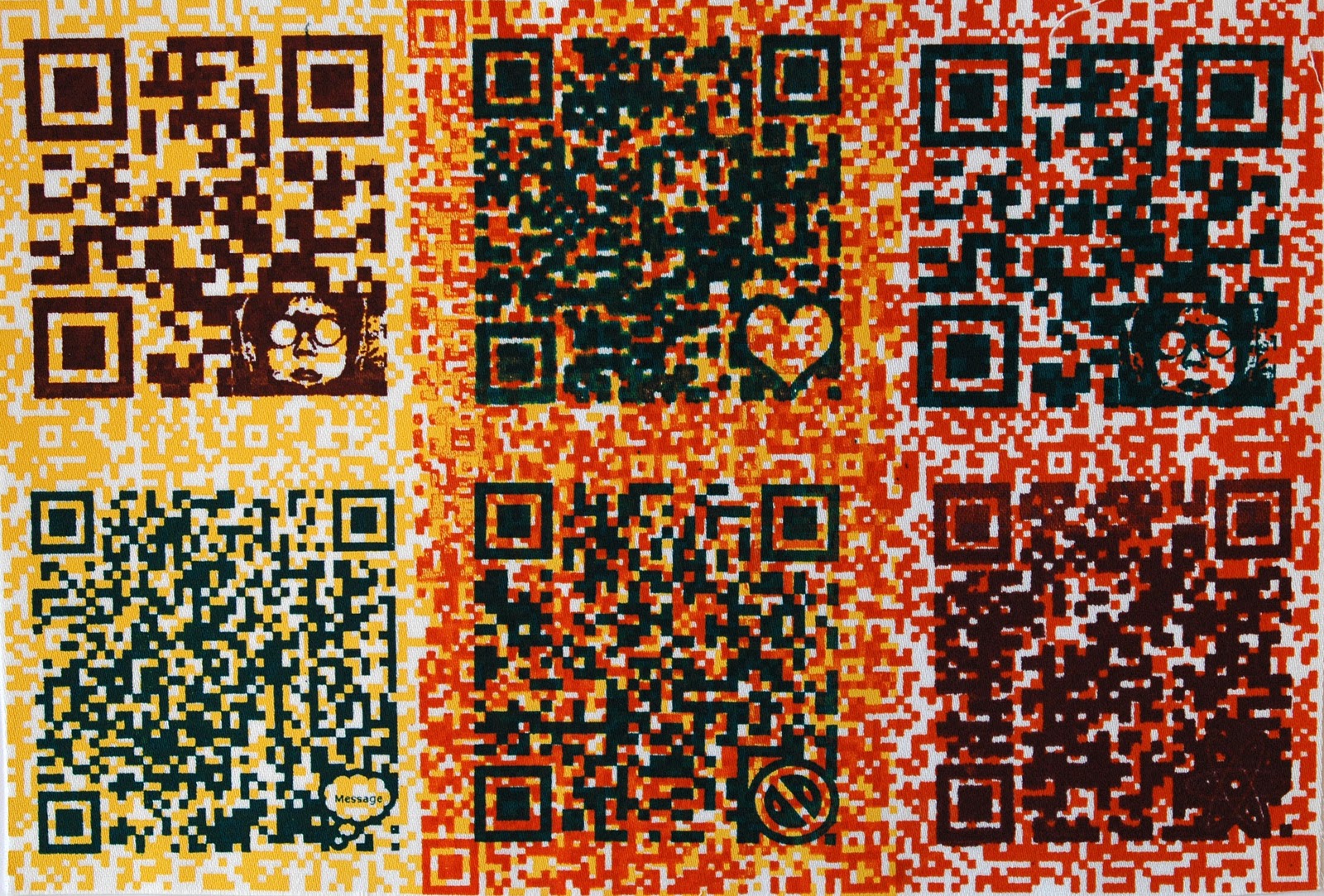
First I found an interesting website called QRlicious. Somehow they manage to change the QR code designs by adding different colours and illustrations into it. They look amazing and they still work. I started to play around and added simple symbols into my codes. It worked absolutely fine when I put them into the bottom right corner. It also makes the codes symmetric which looks quite nice. Although I would definitely design the symbols instead of using basic ones. 

The problem of how to add content to existing QR codes seemed to be solvable as well. I found a couple software on the internet which were free to download. They are mainly for businesses that already printed out many products (mugs, T-shirts, business cards etc.) with codes leading to their websites or to a link for a special event. Obviously they don't want to bin them but update them. The solution called dynamic QR code which can be scanned as a normal one but the content of it could be changed at any time. I couldn't manage to understand how they exactly work but they seem to redirect the code onto another website. Although if I want to make personalised bags I still would need an interactive online shop to communicate with customers what they exactly need on their piece. I wouldn't start to create random codes to random websites just to be changed right after the purchase. But once the bag ends up in a charity shop the new owner can update the codes on the bag and use it as his/her own. 

QRlicious codes

 My personalised codes:


Screen printed on cotton-satin:


 Succesful colour experiments:


 Unsuccesful ones:


It has to be fairly contrasty with the darker colour on top.

I started to concentrate on their look, and create the final design. They all worked apart from the bottom right one but it wasn't working originally either.  
 

More experiments with colour:


After three hours layering my final design emerged. They all work and I love the look as well. 

 I'm very proud of this design so I had to post my grades :) It containts a nice crit as well.